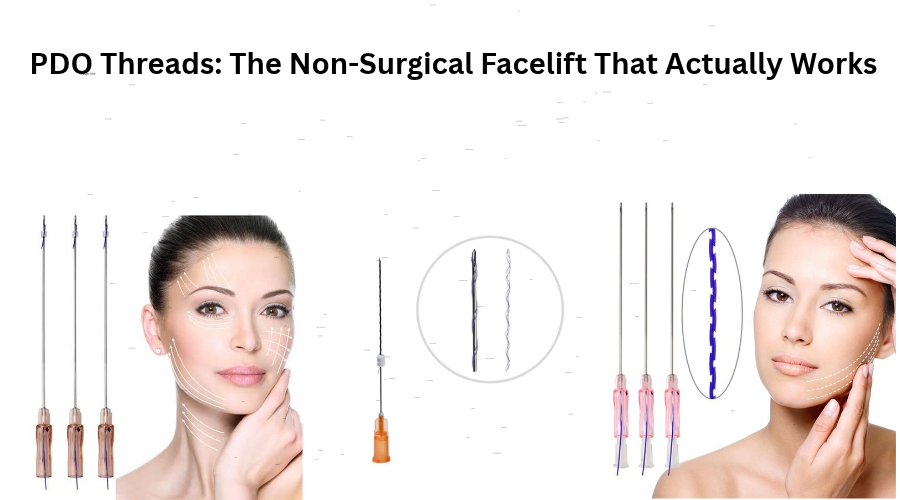
PDO threads are absorbable poly-dioxanone sutures that are inserted under the skin to level up mild sagging and stimulate the production of collagen. Best used for early to moderate laxity; not for jowls or loose skin in the neck. The results will last for 12-18 months. Results vary depending on the type of thread and the injector's technique and skill.
There is always a “lunchtime facelift” every few years, and most last only for a short spell. The concept of PDO threads has been around for a long time, as it's simple and the material has a long track record in surgeries. They are no magic, and they can't be a facelift replacement. They provide real and visible lift to the right patient, though.
This guide will help you understand how PDO threads work, whether there are any, who can benefit, and where the boundaries lie. It also includes what your clinics should look for when buying threads in bulk. Figures are typical industry standards and not manufacturer's claims.
Polydeoxyglucuronate (PDO) is a synthetic polymer that surgeons have used in absorbable sutures since the 1980s. It is degraded by hydrolysis into water and carbon dioxide. Once inserted into the face, a thread will be completely absorbed in approximately 6-9 months, depending on thickness and design.
Esthetic threads are manufactured in fine gages. Smooth mono threads are generally 25-38 mm long and are used with 29G or 30G needles. Cog threads are threads of 60 to 160 mm with 18G to 21G cannulas. They are all sterile, single use and supplied with their own needle or cannula.
Threads work in two ways. The first is a mechanical one. Barbed or cogged threads work to grip tissue and lift it up in small increments, providing an immediate but small lift. The second is of a biological nature. The dissolving thread, with its slight irritation of the tissue, stimulates the fibroblasts to synthesize collagen and elastin.
Mechanical lift decreases as the thread is absorbed. The collagen effect takes 2 to 3 months to work and will still remain. This is why the best results seem to be at the three-month mark, rather than on day one.
Mono threads are smooth and for skin quality. They're inserted in a criss-cross pattern and used to tighten up small lines around the eye, cheeks and neck. They provide minimal lift and are appropriate for people who have early signs of ageing.
Screw threads, also known as twist threads, are manufactured with a twist and add volume to hollow regions, such as the cheeks and temples. Cog threads have barbs cut into the shaft, and they do the heavy lifting. Cog threads are most commonly used for the midface, jawline, and brow area, complementing the mono threads.
Yes, within limits. Studies and clinical experience show the effectiveness of providing a visible lift for mild to moderate, deceptively sunken skin texture. Loose neck skin, deep folds, and heavy jowls are poor responders and, in some cases, will require surgery.
Patients notice their lift immediately after the procedure and typically experience swelling, which can conceal the result. It becomes swollen and tight for 1 or 2 weeks. Collagen gains are best between weeks 6 and 3 months.
A realistic lift is a lift of a few millimeters with firmer and smoother skin. It won't resemble surgery. Clinics should clearly state at the consultation that the procedure is cosmetic; if the patient is not aware, they will leave with a disappointing outcome.
Those who are most suitable are patients ranging from late 30s to 50s who have a slight to moderate degree of skin looseness and skin thickness. May possess early jowls and/or soft jaw line/brow drop. Thin skin, heavy fat pads and deep folds are not successful.
Smokers heal more slowly, and patients with active infections of the skin, autoimmune disease, or blood clotting are not recommended to undergo the treatment. Unless a medical history check is completed, do not book the appointment.
The procedure takes 30 to 60 minutes. The clinician identifies entry and exit sites, cleans the site, and uses topical or local anesthetic. The clinician inserts each thread through the tissue with a needle or cannula, then pushes the opening shut. No stitches are needed. Most patients return to work in 1 to 3 days. After treatment, advice includes sleeping on the back and not undergoing dental work for two weeks or avoiding wide yawning or strong massage for approximately the same period.
Lasting effects are 12-18 months and may even be 24 months in some patients who get cog thread lifts. Smooth mono threads will fade faster. Repeat treatment can be done before the lift is completely gone.
Common and expected are bruising, swelling and mild asymmetry that will improve in 2 weeks. Dimpling, migration of threads and the visibility of threads when measured through thin skin are less common. Very rare, but serious problems are infection and nerve damage and damage to the salivary glands. Most complications are due to lack of technique or poor products. Important is the quality of the threads, and the depth of their placement. Highly-skilled injectors are aware of zones that are dangerous for the face and will avoid them. That is the best of all reasons to select a professional provider over the inexpensive one.
A surgical facelift lasts 8-12 years and lifts sagging, drooping skin; however, it requires general anesthesia and weeks of rest. The fillers have a lifting effect and are used to provide bulk; they will last between 6 and 18 months, depending on the type. PDO threads fall between them. They are neither so severe as to lift much nor do they make much collagen, at midrange prices. Patients who opt for a gentle refresh go for threads. Patients with advanced laxity should be told that surgery is the better option.
Yes. Many clinics offer a combination of PDO threads, skin fillers and radiofrequency or microneedling. The timing is important, request your clinician to explain the timing.
The purity of the materials is most important. Medical grade PDO must have a certificate of analysis and a lot number. Ensure the manufacturer is ISO 13485 certified, and the product is CE marked or approved in the country where it is to be sold.
Sterilization is next. Most threads undergo ethylene oxide sterilization and have a shelf life of 2-3 years. Barb quality is not insignificant as well. Even barb points penetrate uniformly, and rough-cut points often tear tissue and increase complications.
The things every clinic should consider before purchasing bulk lots.
Begin by reviewing some of the rules in your market. Thread regulations differ by country, and some products need to be registered for sale. Request approval documents, not brochures.
Next, review the prices and ordering terms. The prices range from $0.30 to $3 per piece for mono thread and from $3 to $15 per piece for cog thread, depending on the size and the number of barbs per thread. Some suppliers require between 100 and 500 units of each model on the initial order. Before placing an order, ask for samples.
Use PDO threads appropriately for the condition and the patient. They provide a slight but gradual lift and stimulate the production of collagen over time; there is minimal downtime. They are not a substitute for surgery for severe drooping. Clinics should only use certified products and set and keep straight expectations the first time you meet, training your injector on how.
Where can I get PDO threads for purchase in bulk quantity for a clinic?
Purchase from a certified thread manufacturer or approved thread distributor that provides lot-numbered and labeled sterile threads with approval documents.
What is the wholesale price of PDO cog threads?
You can buy cog threads in bulk for about $3 to $15 per piece, depending on gauge, length, and number of barks.
Who is a private-label packaging custom supplier of PDO threads?
Consider manufacturers who can hold you to custom boxes, labels, and sterile printing of pouches, along with product registration support!
Who provides bulk supply of PDO threads with customization at a discount?
Always choose suppliers who manufacture their own thread, as there is no intermediary’s margin cut, and this helps to support the custom specs.
Are PDO threads permanent?
No. The thread is dissolved after 6 to 9 months, and results will last for 12 to 18 months.
Highlights PDO threads are absorbable poly-
READ FULLHighlights -Request ISO 13485:2016, EO sterilization records, and ISO 10993 test report
READ FULLFor owners of medical spas and clinical purchasing managers, confirming
READ FULL