-Request ISO 13485:2016, EO sterilization records, and ISO 10993 test reports from any manufacturer of PDO threads prior to discussing price.
-The bulk price of mono threads typically ranges from USD 0.20 to 1.00. The price range of cog threads varies between $USD 2.00 and USD 8.00.
-MOQs for private label start at about 2,000 – 5,000 pieces per SKU.
-Who is worth keeping is determined by registration paperwork, sample tests, and complaint process.
Most distributors lose money on PDO threads in one of two ways. A shipment is delayed because it lacks documentation, or a clinic tells them the documentation shows broken threads and they no longer need to order. Both problems stem from the supplier. Making the right choice of manufacturer requires some work. Check the following areas, in this order of importance: product range, materials, quality systems, regulation, customization, price, and support.
The manufacturer determines what you can legally sell and how it fails. You are responsible for complaints, recalls, and brand damage. One inappropriate supplier can make even one good batch a bad situation. A strong one provides consistent quality you can rely on.
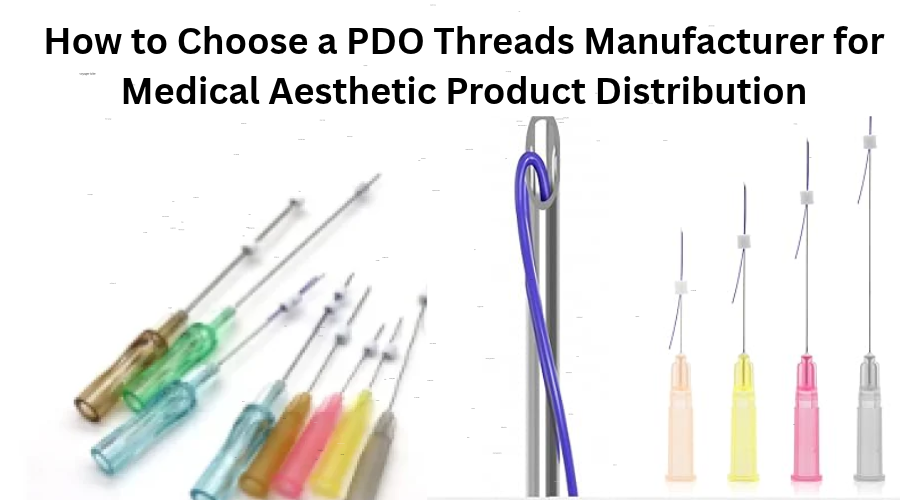
PDO threads are available in three formats. Mono threads are smooth and are used to create skin texture and fine lines. For volume, screw threads are twisted. Cog threads have a barbed construction and are used to lift. If a supplier only has one format, then your clinics will only be able to purchase one format from you. Sizes vary a lot. Typically, mono threads are available in boxes of 100, 29G or 30G, and 25 mm or 38 mm. Cog threads run 18G to 21G and 60 to 190 mm, usually 20 per box. There are needle and cannula types one can get. Firstly, receive a catalog listing the size, length, and cog count of each item.
Polydioxanone is a polymer that can be absorbed. It undergoes rather slow hydrolysis over a period of 6-8 months. The secret to quality is Resin. Inquire about its source and whether they have a certificate with each batch stating the viscosity, molecular weight, and residual monomer. Some manufacturers make their own filament. Others buy it in. Neither is necessarily bad, but in-house extrusion offers more control over diameter. The absorbable suture USP 6-0 should be approximately 0.070-0.099 mm in size; a size greater or less will fail at the needle joint. Request knot pull data on a lot basis.
Production should be conducted in accordance with ISO 13485:2016. Generally, thread cutting and needle assembly occur in an ISO 7 or higher cleanroom. Request the last audit report and when it was issued. But look at the scope of the certificate also. But some of his certificates apply to general plastics, not sutures or threads, and that is a problem.
Ethylene oxide is used for most PDO threads. Confirm the cycle according to ISO 11135, and test the residue according to ISO 10993-7. Pouches should follow ISO 11607. The Biocompatibility testing in accordance with ISO 10993 should include testing for cytotoxicity, sensitization, and irritation. Ask for the factual reports. A line on a brochure is worth nothing!
At minimum, ISO 13485:2016 and CE marking under EU MDR 2017/745 if you sell in Europe. The US FDA establishment registration is helpful. All certificates should be up to date, specify the scope of the products, and should have an expiry date that is valid and known to the issuing body.
There are country variations in rules. The EU MDR 2017/745 applies to threads, including the requirement for a notified body and UDI marking. PDO threads are typically marketed as absorbable sutures in the US for this reason. Brazil, Korea, and the Gulf states all have a unique enrollment process. Registration is slow. Think long-term, minimum 3 months. A well-manufactured product includes the technical file, instructions for use, sterilization validation, and, if applicable, a free sale certificate. The last thing that needs to be decided early here is who is registered. If it's the factory's name, you'll have little leverage at the end of the contract.
Private label is a product that will let you create your very own brand. Custom boxes, custom pouches for your logo, and your product names are all to be expected. The typical MOQ varies from 2000 to 5000 pieces per SKU. Add artwork, label translations, and regulatory text costs separately. They often are. Bigger changes cost more. If there is a change in length, gauge, cog angle, or needle type, then new tooling and fresh validation are required. A typical manufacturing lead time is 30-45 days. First, the signing of a quality agreement for change control and lot traceability. If not, an unannounced change in resin supplier ends up in your clinics.
All prices of Monothreads are in the range from USD 0.20 to USD 1.00 per unit, with volume discounts available. Cog threads are available in a range of $ 2- 8. Quotes that are well outside of those ranges are cause for concern. They can use recycled polymer or not be validated. Discuss landed cost; extras of freight, duties, and tests could be from 15% – 25% of the ex-factory price. Stock products typically have a stock status of 500-1000 and take 7-15 days to ship. Custom Runs take 30 – 45 days. Inquire about discounts at 5,000 and 10,000 pieces and about the payment conditions. A lot of the suppliers will charge some sample fees on the first purchase, so ask before you pay twice.
How to Test PDO Thread Samples Before Ordering?
Purchase 20-50 units in one lot. Examine cog sharpness, cog shape, pouch seals, and label accuracy. Have a trusted clinic do test insertions and send the lot to a third party for tensile testing.
Every pouch should include the following information: product name, gauge, length, lot number, expiration date, sterilization method, and UDI if applicable. Shelf life is usually three years from the sterilization date. Ask to see stability data in support of this claim. Boxes should include instructions in your target market’s language. Inspect the sterile barrier manually. Seals should be flat and free of foldings or wrinkles. On arrival, open one pouch and look at the thread. This is a sign of more of a factory than its sales deck, as these result in kinks, loose cogs, or bent needles.
All paperwork comes with product. Commercial invoice, packing list, certificate of origin, certificate of analysis and sterilization certificate are required. If this is not there a container can sit idle for weeks. Pick suppliers that know your area and make sure you understand the trade terms such as FOB, CIF or DDP. EO-sterilized materials should be kept below 40°C.
Post-delivery support will show you the supplier's behavior in case anything goes wrong. Request a written complaints procedure that will provide a response within 48 to 72 hours. Ask about the vigilance procedure and the recall plan. Training material and clinical documentation for your sales team are a bonus. Put replace-or-refund terms for defective lots in the contract.
If a supplier cannot provide certificates or doesn't know its sterilization facility, walk away and seek a different supplier. If products do not contain lot numbers, walk away. If prices are significantly below market, or papers are obviously worked, there's a strong reason to rethink such an offering. So does any claim of permanent results. PDO is absorbable, and no honest supplier would guarantee a "lift that lasts forever".
The best PDO thread maker is the one who can back up its claims. Begin with certificates, sterilization and tensile data.Then check price, MOQ, private label terms. Test a sample lot before placing any large orders. Read the contract at registration on ownership of the lot and the defect terms. A supplier that will provide documents is likely to be safer than the one with the lowest quote.
Where can I buy PDO threads in bulk?
When ordering threads, purchase from a certified PDO thread manufacturer that offers distributor terms, 500–1000–piece lots, and sterile, labeled packaging.
What is the wholesale price of PDO threads?
Price starts at about USD 0.2-1 per mono thread and USD 2-8 per cog thread, depending on volume.
Who is a custom supplier of PDO threads with discounted rates?
Find the right ISO 13485 manufacturer with private label, custom specs, and tiered discounts from 5,000 pieces.
Who offers bulk and custom PDO threads from one supplier?
Choose a factory that does catalog lines and custom orders as well; a single bid to them covers both.
How long is the lifespan of PDO threads?
The PDO threads break down within 6 to 8 months, and the results of collagen can be seen for 12 to 18 months.
Highlights -Request ISO 13485:2016, EO sterilization records, and ISO 10993 test report
READ FULLFor owners of medical spas and clinical purchasing managers, confirming
READ FULLHighlights Certificates and batch records are more important than price list. Wholesale
READ FULL