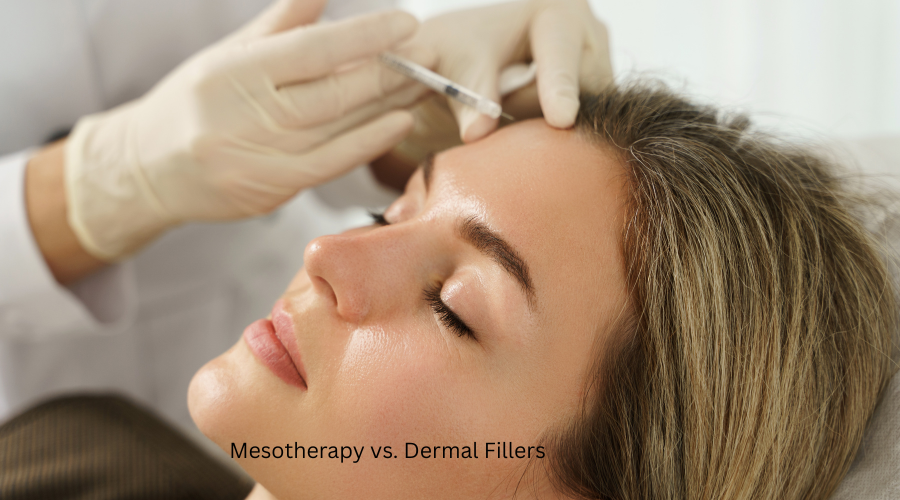
Mesotherapy vs. Dermal Fillers: Explained Simply
Your clients are asking smarter questions than ever before. They are coming in with research and a clear idea of what they want. And somewhere in that conversation, the words "mesotherapy treatment" and "dermal fillers for skin rejuvenation" keep coming up -- often in the same breath, often confused for one another.
But the real truth is that both these treatments are not interchangeable. They serve different purposes, suit different clients, and deliver very different results. If you are running an aesthetic clinic or building a treatment menu from the ground up, understanding exactly where each one fits is crucial for your clients.
This blog will give you a simple breakdown of both treatments clearly. We will do a side-by-side comparison. In the end we will give you an actionable framework for deciding what belongs on your aesthetic treatment menu.
What Is Mesotherapy Treatment?
Mesotherapy is a non-surgical cosmetic treatment that involves injecting a mix of vitamins and enzymes directly into the mesoderm, which is the middle layer of the skin. The injection is potent and acts as targeted nutrition delivered exactly where the skin needs it most.
The chemical formulation of the injection consists of a customized blend of vitamins, enzymes, hormones, and plant extracts designed to achieve skin rejuvenation and tightening. In some cases, it also remedies the problem of excess fat or cellulite. The cocktail can be tailored to each client's concern, which is a major part of its appeal.
Mesotherapy is a versatile treatment option that can address a variety of skin concerns like aging, sagging, and hyperpigmentation. It also addresses hydration and overall skin texture. For many patients who want visible improvement but are afraid to under the knife this is a go-to option that is hassle-free and relatively quick.
The success rate of mesotherapy is proven. A 2025 study in mesotherapy found that recipients had significantly better skin hydration and elasticity compared to a control group. Clinical research also shows significant increases in skin brightness and wrinkle reduction within two months.
In terms of protocol, expect a course of sessions rather than a single appointment. Results are gradual in this type of treatment and downtime does not disrupt the schedule. Most clients experience mild redness or swelling that resolves within a day or two.
An important thing to keep in mind to ensure that your practice remains fully compliant and you do not run into legal trouble is to confirm that the mesotherapy formulations you are applying are FDA-approved. Your sourcing, documentation, and informed consent process need to reflect that.
What Are Dermal Fillers for Skin Rejuvenation?
Dermal fillers are injectable treatments that work by adding volume beneath the skin. Adding volume has a dual purpose: it smoothens wrinkles and enhances facial features. The filler is a gel-like substance injected beneath the skin to replenish lost volume, smooth deep creases, and improve facial contours.
The common variant of filler that has been adopted worldwide by clinics worldwide is the hyaluronic acid filler. Hyaluronic acid is a naturally occurring substance in the body that helps maintain moisture and skin elasticity. Apart from HA, othet
types of dermal fillers include calcium hydroxylapatite and poly-L-lactic acid (PLLA) fillers. These fillers have their own longevity and mechanism.
HA fillers typically last 6 to 24 months. Calcium hydroxylapatite has an effective life of 18 months, and PLLA is a long-term treatment filler that can remain effective up to 2 years. That long-term value is a strong selling point for clients who want to balance cost with treatment frequency in the long-term.
HA fillers are classified as Class III medical devices by the FDA and are approved for adults over 21 for various facial and hand indications. Approved indications include the lip, cheek, perioral rhytids, nasolabial folds, infraorbital hollowing, jawline, and temple augmentation.
Mesotherapy vs. Dermal Fillers: The Head-to-Head Comparison
Here is where it gets practical. Use this table as a quick reference when advising clients or building your treatment menu.
|
Factor
|
Mesotherapy Treatment
|
Dermal Fillers
|
|
Primary Goal
|
Hydrate. Smooth. Refresh skin. |
Restore volume. Shape face. |
|
Mechanism
|
Micro shots into skin layer. |
Gel placed under skin. |
|
Ideal Candidate
|
Early aging. Dull tone. Fine lines. |
Deep folds. Hollow cheeks. Uneven face. |
|
Sessions
|
Many. 4–6 typical. |
One. With upkeep. |
|
Downtime
|
Short. 1–2 days. |
Short. 1–3 days. |
|
Longevity
|
3–6 months. |
6 months to 2+ years. |
|
FDA Approval
|
Not approved as combo. |
Approved (HA, CaHA, PLLA). |
|
Reversibility
|
No reversal. |
HA fillers reversed with enzyme. |
|
Price Point
|
Lower each time. Adds up. |
Higher each time. Lasts longer. |
|
Best For
|
Skin health. Non‑surgical glow. |
Structure. Targeted correction. |
The takeaway is straightforward. Mesotherapy provides a broad-spectrum approach to skin health and subtle enhancement, making it ideal for clients seeking overall rejuvenation. In contrast, dermal fillers deliver targeted volume restoration and contouring, suitable for those looking to address specific aesthetic concerns.
They are not competitors. They solve different problems.
Can You Offer Both? The Business Case for a Combination Menu
The short answer is yes. And your competitors who already do are seeing the results.
Personalized treatment packages or combination therapies command a 20 to 40% premium over single-product procedures. That is not a small margin. That is a meaningful revenue shift that comes simply from offering a more complete service.
Clinically, the two treatments complement each other well. A client might benefit from a course of mesotherapy treatment to improve overall skin quality and hydration, followed by targeted dermal fillers for skin rejuvenation to restore volume in specific areas. One addresses the canvas. The other addresses the structure.
The aesthetic injectables market is transforming with the growing preferences of clients for subtle and regenerative results. Healthcare providers have adopted new technologies, bio-stimulatory formulas, and data-driven precision to offer long-lasting and natural outcomes. Offering both treatments positions your clinic at the center of that shift.
Before adding either treatment, make sure your team has the appropriate training and that your documentation process covers informed consent, product lot numbers, and emergency protocols. Record product brand, lot number, and a clear emergency transfer plan. Explicitly document that certain mesotherapy mixes may be off-label and discuss realistic expectations and risks with your clients.
How to Choose What Is Right for Your Clinic or Business
The right treatment to add depends on where you are starting from and who your clients are.
For an established clinic owner or manager,
Ask yourself these questions before expanding your treatment menu:
- What is the primary concern of your existing client base -- skin quality or structural volume loss?
- Do you have or can you access a certified injector trained in both minimally invasive cosmetic procedures?
- What is your average client lifetime value, and which treatment better supports repeat bookings?
- Are your suppliers providing fully documented, traceable products?
For a beauty entrepreneur
If you are building a new offering from the ground up, the path is slightly different:
- Start with a clear understanding of your target demographic before choosing a treatment category.
- Mesotherapy has a lower barrier to entry in terms of per-session cost and product investment, making it a practical starting point.
- Dermal fillers carry greater regulatory responsibility and require FDA-compliant products and qualified practitioners.
- Whichever direction you choose, your supplier relationships and training credentials are your two most important assets.
Your competitors are already offering these treatments. The window to differentiate through quality, expertise, and a well-rounded menu is right now.
Conclusion
Mesotherapy vs. dermal fillers is not a battle. It is a spectrum. One treatment builds skin health from within. The other restores structure and volume with precision. If you merge both these, then you have a powerful combination that gives a comprehensive answer to what your clients are actually asking for.
The next step is the same: align your treatment menu with real client demand. Then invest in proper training of your staff regarding these treatments and source from credible, documented suppliers.
FAQs
Is mesotherapy FDA approved?
No. Not as a full product. Many cocktails are mixed and not FDA‑approved. Some ingredients, like hyaluronic acid, have approval. Tell clients. Write it down.
Can mesotherapy and dermal fillers be used together?
Yes. They work well side by side. Mesotherapy hydrates and smooths. Fillers add shape and lift. Certain HA blends make both safe together. A skilled hand sets the plan.
Which treatment is better for skin rejuvenation?
Depends. Want glow, fine line care, better skin health? Choose mesotherapy. Want instant volume, sharper contour? Choose fillers. Often, both give the best result.
Related Articles