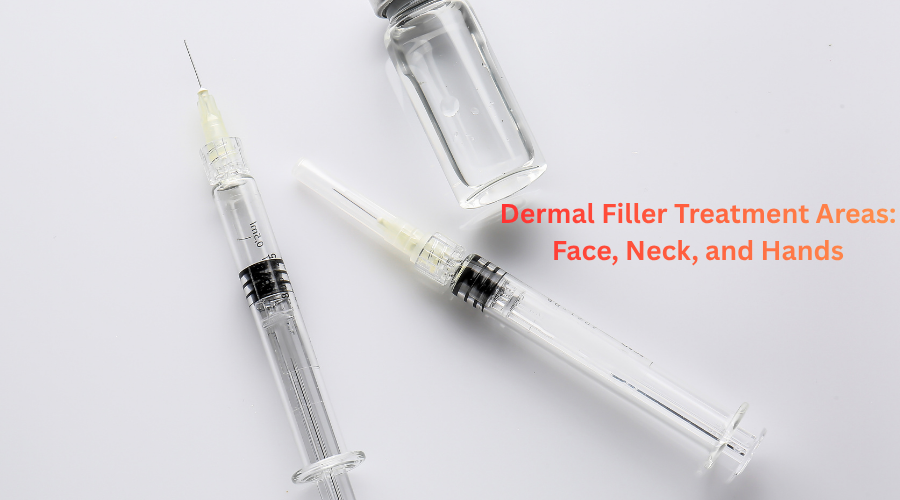
As people age, the biggest change they experience is the loss of their youthful appearance. This is the reality every person has to face, and some people follow a healthy lifestyle to slow it down. People follow a healthy diet, workout, skincare routine, and stress-free lifestyle to alleviate aging signs. Some people go for medical aesthetic treatments, which are like a shortcut. All they have to do is choose a certified medical aesthetician for dermal filler treatment on the face, neck, and hands. But what kind of areas do dermal fillers treat? Is it just about adding volume or more than that? Find out everything in this blog.
There are over ten areas on the face that are treatable by dermal fillers. From the forehead to the chin, many spots get aging lines, loss of volume, and paleness. Forehead, temples, eyebrows, cheeks, and nose are those areas. Also, lips, jawline, chin, and some other surrounding spots on the lower face need dermal fillers. Here are all the details you need to know.
Some people get prominent aging lines on their upper facial area. Forehead lines are the most common aging lines that need treatment. Dermal fillers add volume in that region and hide the forehead lines for around 6 or 12 months, normally.
Then some people have sunken temples because of aging and poor diet issues. Their temples start getting sunken because of the loss of collagen, mostly. To recover that volume, medical aestheticians inject dermal fillers.
Then there is a third region in the upper face, which is the eyebrows and eyes. People get frown lines between their eyebrows, which become very apparent. Some get crow’s feet right at the end of the outer border of the eyes. This is the skin between the eyes and temples, which gets aging lines. Then some people get tear troughs because of aging or stress. They appear like dark circles, hollowness, and dryness. To add volume in that region, medical aestheticians use dermal fillers.
Then comes the mid-section of the face, and we will talk about the cheeks first. Many people get sunken cheeks because of aging, poor diet, and various other problems. To restore that lost volume and do contouring, doctors use dermal fillers.
Then there is another part of the mid-section face, which is the nose. People get dermal fillers for the symmetrical look of their nose if there is any apparent issue with their nose. Dermal fillers help contour and balance the nose.
Nasolabial folds or smile lines sometimes become permanent and very visible. They appear at the upper sides of the mouth when smiling or sometimes all the time. To reduce their appearance, medical aestheticians use dermal fillers. They add volume in that area to hide these lines.
They are similar to nasolabial folds, but they appear on the sides of the mouth. They increase as a person ages, and these lines occur because of the loss of collagen. Dermal fillers help hide them by adding that lost volume in that area.
Then there are vertical lines or smoker lines. These tiny wrinkles appear right at the upper lip. They appear more as a person ages. Dermal fillers add volume to hide them temporarily. Besides, doctors do lip augmentation to add symmetry to the lips and add volume. This treatment makes the lips look fuller and plumper.
Jowl line covers sagging skin under the jaw and chin. Doctors use dermal fillers to reduce skin sagging, which is also called a jowl lift. Then some people need jawline augmentation, and dermal fillers help tighten that region. These two treatments are part of a facelift that makes a person’s face tighter in the lower region.
These are folds in the chin area that come as a person ages. Medical aestheticians use dermal fillers to add volume to the chin. That makes a chin smooth and fuller by temporarily disappearing creases, lines, and folds.
As a person gets older, the skin becomes saggy. That makes the neck appear loose, and people experience horizontal neck lines. That happens because of skin thinning or loss of collagen. Doctors inject dermal fillers to restore volume in the neck’s skin. As a result, the neck appears smooth, wrinkle-free, and tight.
People lose collagen not only on their faces and necks, but also on their hands. The skin starts becoming thin, and the hands show the signs of aging really fast. That loss of volume brings wrinkles, paleness, looseness, and thinning. Doctors use dermal fillers to add volume that temporarily makes the hands look elastic, radiant, and smooth. The wrinkles and sagging disappear for up to 12 months.
Dermal fillers are a versatile solution for aging lines, sagging, dullness, and hollowness. The loss of volume occurs when the collagen starts deteriorating. It is a normal process of aging, and it happens to everyone. Some people prefer medical aesthetic treatment via dermal fillers and get a temporary return of youthful looks.
What Do Dermal Fillers Do to the Face?
They add collagen, radiance, and hydration that hide aging lines. They also tighten the skin and add symmetry to the lips and nose.
Do Dermal Fillers Work on the Neck?
Yes, they work on the neck. They temporarily treat skin sagging and vertical lines in the neck.
Do Dermal Fillers Work on Hands?
Yes, they work by adding volume. They restore the collagen and tighten the skin to make hands look youthful temporarily.
Where to Procure Dermal Fillers for Medical Aesthetic Treatments?
You can find many reliable names in the industry. Just make sure you buy certified and tested dermal fillers. You can also choose distributors like Golden Toad Co., Ltd. for bulk supply of dermal fillers. It has various branded fillers for medical aesthetic treatments.
How to Find a Dermal Filler Distributor for My Clinic?
You can explore options on a B2B platform, and one of them is Golden Toad Co., Ltd. This global distributor has branded dermal fillers at wholesale rates.
Highlights PDO threads are absorbable sutures used in thread lifting. A compete
READ FULLPDO threads are medical devices. A low price is not e
READ FULLBotulinum toxin is one of the most commonly used medicinal products for both aesthetic and therap
READ FULL