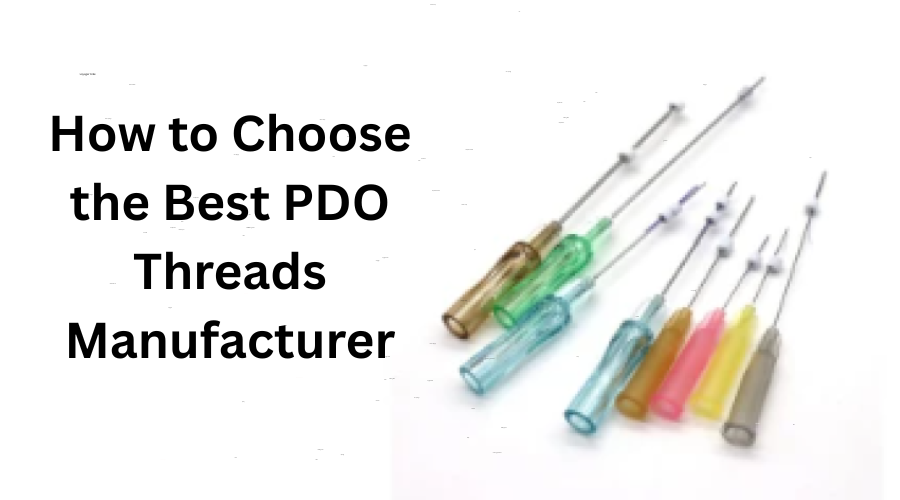
A trustworthy manufacturer of PDO threads offers CE and ISO 13485 for each batch.
Clinical outcomes are directly related to thread gauge, absorption time, and mono/cog/screw types.
Usually, 100-500 boxes are the MOQs for wholesale PDO thread orders.
Documentation for sample testing and sterilization avoids expensive problems later on.
PDO thread manufacturers are crucial for the sourcing process of Clinics and distributors when ensuring consistent quality of service. Poor-quality thread can affect absorption rates, resulting in uneven lifting, faster absorption, or clinical complications. This article guides you on what to evaluate before hiring a manufacturer of PDO threads for bulk or repeat orders.
Thread quality directly influences the outcomes of aesthetic procedures. When not consistent with the polydioxanone composition, threads will absorb excessively or unevenly. This reduces the length of lifting time that patients may require after treatment. Improperly sterile devices pose a significant infection risk for clinics. If one batch gets contaminated, it may cause an infection or a regulatory inquiry. Clinic reputation and patient safety are two reasons that manufacturer reliability is important.
Certifications ensure that a medical device manufacturer has met safety requirements. If you place orders for threads in the European market, they will have to be CE-marked. This proves compliance with EU medical device regulations. ISO 13485 certification shows a quality management system designed for medical devices. This standard focuses on consistent production, testing, and traceability. When ordering in bulk, always ask for up-to-date certifications.
Manufacturers intending to supply the U.S. market will find FDA clearance important. Request the product-specific 510(k) clearance number. This is to certify that the threads passed have undergone regulatory scrutiny. Manufacturers located in South Korea, a large thread hub for PDO, are eligible for FDA authorization. This certification is for demonstrating conformity with Korean medical device standards. Ask for proof of any kind, whatever your market is.
Material quality begins with the purity of polydioxanone and the homogeneity of its molecules. Quality PDO threads have a set absorption period, ranging from 4 to 6 months. Stickiness can cause threads to break apart in 2 months or less if the material is inconsistent. Ask about the range of thread sizes the manufacturer offers. General gauges range from 26G to 30G, depending on the body area being treated. Smaller sizes are better for finer areas of the face; larger sizes are better for body contouring.
For fine lines, mono threads provide smooth and low-stress lifting effects. Cog threads have barbs that grip the tissue for greater lift. Volume and texture improvement: screw threads have a spiral design. Ensure that all three types are manufactured by the same manufacturer with consistency. Different types of thread are commonly required for different treatment protocols in clinics. Clinical flexibility is greatly limited when the product range is limited.
The price is different as per different thread types, gauge, and packaging format. Wholesale pricing is typically $0.80-$2.50 per standard mono thread. Cog and screw threads can be about 20% to 50% more expensive because of construction complexity. Typical MOQs for wholesale orders of PDO thread begin at 100 boxes and go up to 500. For new clinic partnerships that are testing the product, some manufacturers might provide MOQ discounts. Distributors with larger order volumes can get better prices at the 1,000-box level.
Each color is sold as private label packaging over and above the base packaging thread costs. The cost of custom box printing usually ranges between $0.10 and $0.30 per box. The price of simple label branding is less than full custom packaging design. Request several pricing tiers, based on varying order sizes. Many manufacturers have a 10-25% discount for higher quantities. This helps distributors plan years in advance to purchase goods with cost efficiency.
Every produced batch will be consistent if production standards are applied. Established manufacturers have dedicated cleanrooms with ISO Class 7 or higher classification standards for thread production. This helps lower the possibility of contamination during manufacturing and packaging. Typical lead time for bulk PDO thread orders is 15-30 days. Add 7-10 days for custom packaging or private-label branding. Double-check lead times prior to placing an order for any purchased items.
Ethylene oxide (EO) is still the most common method for sterilizing PDO threads. The residues of EO shall be within the safety limits as defined in ISO 10993. This prevents irritation or upset upon application. PDO threads typically have a shelf life of 2-3 years. Always double check the manufacture date with each shipment. Expiring goods reduce the useful shelf life of your clinical products.
Sample requests can catch quality problems before they affect patient treatments. Samples from most manufacturers will arrive within 5-10 business days. Ask for a product sample; it is usually returned if you place an order later. Check samples for sharpness, even thread, and seal condition of the packaging. If known, assess the smoothness of the test cannula during insertion for evaluation. A variation in a sample is usually reflected in the entire production batch.
Request references from other clinics or manufacturers. Any PDO threading manufacturer could tell you about their own customers. A lack of references may indicate that the company has less production experience. Research the aesthetics medical device manufacturer's experience. More consistent results are usually seen in manufacturers with 8+ years of operation. Newer manufacturers may also function well, but have a higher risk initially.
Lots of compliance problems occur when buyers go for the lowest quote and don't check certificates. Manufacturers who are not certified can send it for clinical safety review and import inspection, and even if they fail the test they can still send the thread. Please always double-check the CE, ISO, FDA/KFDA paperwork before you pay.
Bulk buyers never want to skip the sample stage, as it can prove to be a very expensive error. Most of the time, you won't suspect gauge, sterility, or packaging issues until the threads reach the clinic. Small sample orders can avoid needless reorders or safety incidents.
Not keeping up with shelf-life documentation can lead to inventory issues as well. Limited shelf-life products shorten the amount of time you have to use your stock. Always inspect the manufacture dates before agreeing to accept a big consignment.
The ideal PDO thread supplier ensures patient safety and the clinic’s reputation. Certifications, thread quality and sterilization standards ensure costly compliance issues are eliminated. Stable clinical efficiency and guarantyd availability of goods for every purchase with support of a reliable producer.
Where can I buy PDO threads wholesale for my clinic?
Contact a PDO thread manufacturer that provides CE certification, sample threads, and tiered bulk pricing.
What are the general MOQs for wholesale PDO thread orders?
Most manufacturers need 100-500 boxes to buy PDO thread wholesale.
Where can I find a reliable supplier for PDO threads using a private label for packages?
Look for manufacturers that hold ISO 13485 certification, customize packaging, and have production capacity documented.
What is the price of the PDO threads when you buy from wholesale suppliers?
The price of standard mono threads is $0.80 to $2.50 per unit at wholesale order quantities.
Is it possible to order at a bulk rate and custom print on the same order?
Yes, most manufacturers offer a minimum order quantity, but this minimum is higher if they offer the private-label service.
A trustworthy manufacturer of PDO threads offers CE a
READ FULLWhat Do PDO Threads Do to a Patient or Applicant?
READ FULLHighlights -A wholesale Botox supplier guarantees verified certification documentation
READ FULL